Lidar speed gun — built to
Isolate one vehicle
A narrow beam an officer aims at a single car to single it out of a stream of traffic. Precise, deliberate, one target at a time.
How RoadDefender Works
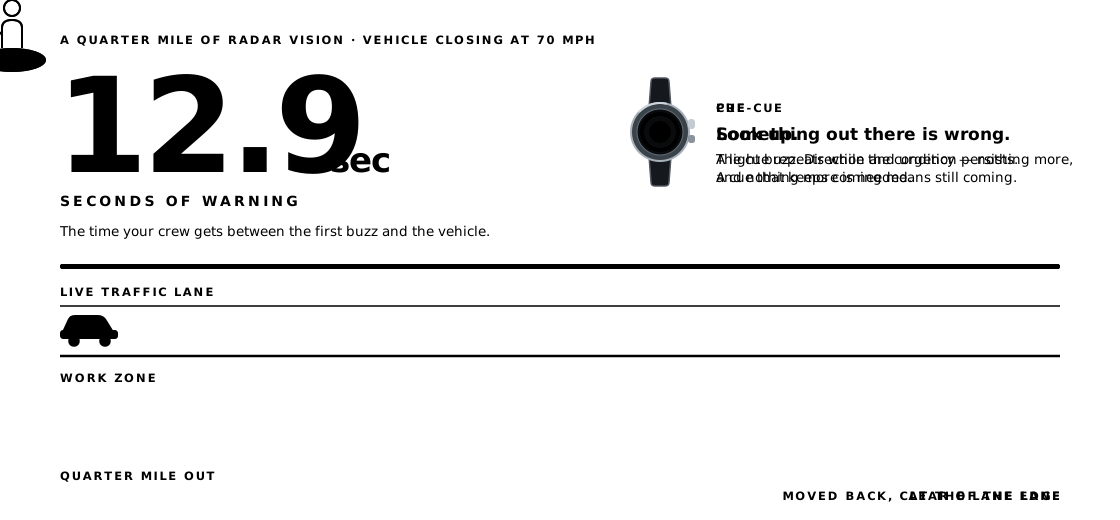
You can’t stop every car. We give your crew the one thing a barrier can’t — a warning, on the wrist, about twelve seconds before it matters.
Detect
Radar measures every approaching vehicle’s speed directly against the threshold your team sets for the zone — a pre-cue the moment a vehicle breaks it, then a cue if it keeps closing. Traffic inside the rule never raises an alert.
Alert
The cue reaches the worker’s wrist immediately, on the radar rule alone. Camera AI then classifies what it was — intrusion, speeder, erratic driver — to sharpen the response and the record. Camera context is in active field validation.
Document
Every event is recorded with the scene around it: where the vehicle went, where the crew was standing.
At the work point
Radar sees the vehicle coming and puts a warning on the worker’s wrist. The camera classifies what it was. Both attach directly to a rugged tablet at the zone — and every decision is made there, on site, with nothing between the sensor and the crew.
Detects
The safety sensor. Measures approach speed directly, through rain, dust, glare and dark, against the threshold set for that zone. It warns early rather than waiting to be certain — certainty costs time the crew doesn’t have.
Radar alone is enough to reach the worker.
Classifies
Answers what radar can’t: whether this was a real intrusion, a speeder or erratic driving, and where the vehicle was relative to the crew. It sharpens the response and records the event — it never gates the warning. In active field validation.
Footage stays on the unit unless you forward it.
Decides
Our software holds the whole chain: it reads the radar, interprets the camera, decides what the crew needs to know, and sends it. No gateway, no server, no round trip — the decision happens on the same device the sensors are plugged into.
Runs on a rugged tablet at the work point, which doubles as the local display.
Warns
On the crew’s wrists. A multi-sensory alert delivered straight from the unit — not to a dashboard a driver may never look at.
On the worker, not on the equipment.
The division of labour: radar decides whether the warning fires, the camera describes what it was — and the radar never waits for the camera. Protection never depends on coverage; live supervisor video does.
Role-based delivery
One event, three audiences: the worker who has to move, the supervisor who has to decide, and the operations team that reviews it later.
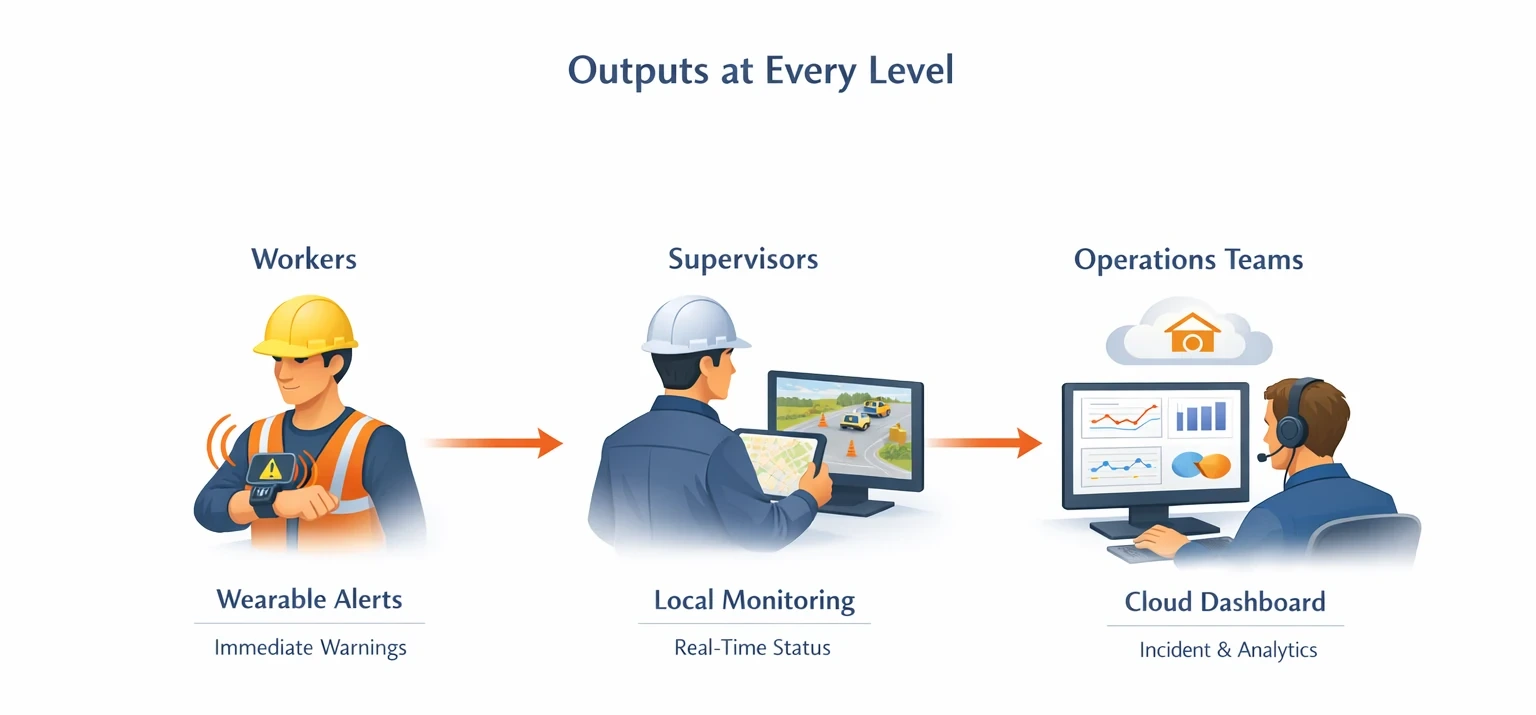
Outcome: Workers get direct, personal alerts — an early cue when a vehicle starts behaving wrong, escalating if it keeps closing.
Outcome: Supervisors get live local context to make immediate work-zone decisions.
Outcome: Operations teams get optional cross-site visibility for oversight and review.
Key takeaway: Workers, supervisors, and operations teams see the same event from three angles — with the worker’s warning always delivered on-site first.
Watch Field ValidationYou asked us
It’s a fair question — and the answer surprises people. Police use both radar and lidar, and radar came first. An officer reaches for a lidar gun for one reason: a narrow beam lets them aim at a single car and pull it out of traffic. A work zone needs the opposite.
Lidar speed gun — built to
A narrow beam an officer aims at a single car to single it out of a stream of traffic. Precise, deliberate, one target at a time.
RoadDefender radar — built to
Continuous, unattended coverage of every vehicle on approach — no one aiming anything — through rain, dust, glare, and dark.
Same physics family. Opposite jobs. RoadDefender runs a camera too — it classifies what the radar caught and reads the scene inside the zone. That is exactly why optics never gate the warning: the sensor that can be blinded is not the sensor the worker depends on.
Works when it has to
Radar reads through rain, fog, dust, glare, and darkness. Optical sensors degrade in exactly those conditions — and a work zone is dusty, wet, and round-the-clock. An alarm that fails in a dust cloud isn’t an alarm.
Answers the real question
The only thing that matters is whether a vehicle is coming in too fast. Doppler radar measures speed natively, so what sets the warning off is a physical measurement rather than something inferred from video frames. The camera’s work starts after that.
Physics, not probability
What triggers the warning is a fixed physical rule — the speed threshold your team sets for the zone — not a confidence score you have to argue about. The camera’s classification sharpens the response afterwards; it never decides whether the warning happens. That makes the trigger easier to trust, easier to certify, and easier to stand behind. Camera classification is in active field validation.
See how RoadDefender gets the warning to your crew across the work zone.
Get a Quote